
Review - Sirāt

Starring Sergi López, Bruno Núñez Arjona, Stefania Gadda, Richard ‘Bigui’ Bellamy. Written by Oliver Laxe and Santiago Fillol. Directed by Oliver Laxe. Rated R. 115 minutes. In theaters.
“Is this what the end of the world feels like?”
“I don’t know, Bigui. It’s been the end of the world for a long time.”
-dialogue from “Sirāt.”
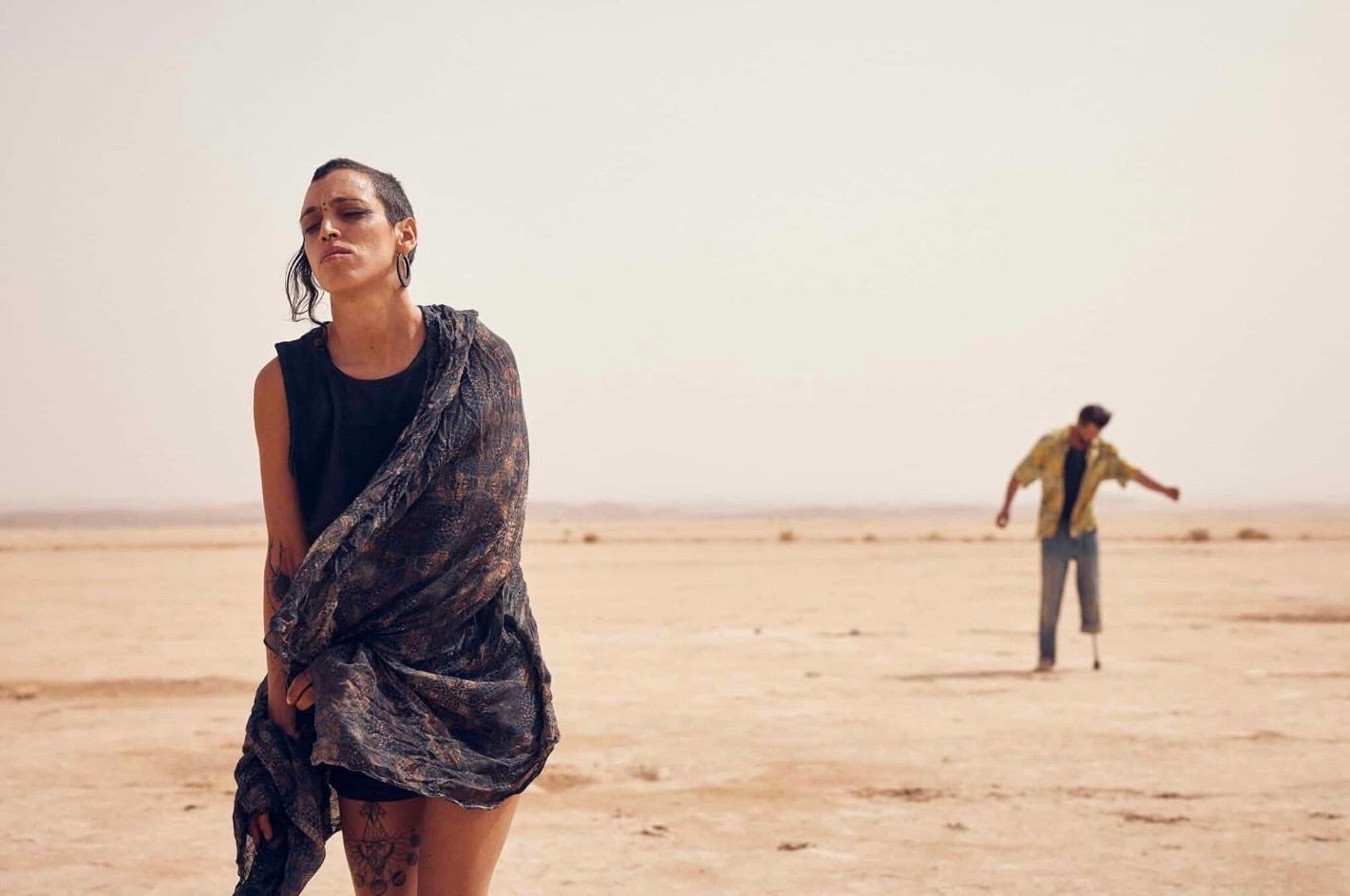
Director Oliver Laxe’s unbearably suspenseful fourth feature is a dance party on the edge of the apocalypse that becomes a harrowing journey into the abyss. Sort of like Gaspar Noé’s “Climax” by way of “Mad Max: Fury Road,” the film begins at a desert rave somewhere in Morocco, where outcasts and dropouts have come to get their grooves on; getting high and losing themselves in the throbbing techno beats.
There is a man there who looks like he doesn’t belong. Played by the great Catalan actor Sergi López, he’s traveled many miles searching for his runaway teenage daughter. The man has brought his adorable young son (Bruno Núñez Arjona) and their little dog, too. The daughter is not here, but she might be at the next rave – there’s always another rave – which is being held across a treacherous stretch of mountain terrain. Nobody thinks the man’s van will be able to make the arduous journey. “It’s what I’ve got,” he says.
The man and the boy (and their little dog, too) fall in with a friendly band of travelers who agree to show them the way in exchange for a few cans of petrol. Played by non-professional actors the filmmaker recruited at real raves, these smiling, middle-aged nomads are covered in scars and unexplained amputations. The man is wary of them. The little boy thinks they’re cool. We like them, too. There’s a serenity about these people. They know who they are.
War has broken out, again. We hear ominous snippets of radio dispatches and see military vehicles barreling down desert roads. Is this the big one? Who can say? It all seems so far away, yet too close for comfort all the same. “Sirāt” has a nasty way of reminding us that it only takes a moment for the entire world to change. Especially your world. Bad things happen in this movie, things that aren’t usually allowed to happen in movies. And they happen so so swiftly, without any foreshadowing or directorial telegraphing, that the audience is as shellshocked as the characters trying to absorb them. “It can’t be,” one of them cries out in anguish. Yet it is.
With the mesmerizing, synth-pulse soundtrack and vast desert spaces, Laxe is working in the mystic tradition of filmmakers like Werner Herzog and Andrei Tarkovsky, but with the white-knuckle ruthlessness of an action craftsman. Given the vehicular trauma and dreamy electronic score, the closest comparison is probably William Friedkin’s 1977 “Sorcerer,” an even more pitiless remake of Henri-Georges Clouzot’s “The Wages of Fear” that featured music by Tangerine Dream. People famously hated “Sorcerer” when it came out, and I know folks who despise “Sirāt.” A friend left the film saying he wanted to drown the director in a puddle of radiator fluid. I don’t share his reaction, but I understand it. The movie works you over.
Still, I feel like “Sirāt” is more than just the exercise in chic nihilism it’s been described as by its detractors. For starters, Laxe is an enormously empathetic filmmaker (unlike say, Friedkin) and these characters are all granted very specific moments of warmth and grace – which might make what happens to them even harder to take. There’s nothing in the way of conventional exposition. We don’t learn about their backstories, or heaven forbid their “emotional arcs,” yet we come to care about the people on this journey. During his time with the nomads we can see the López character coming to an understanding of his daughter and what she saw in this life. He even sort of communes with her in absentia during a scene that takes place after words have lost all their meaning.
I first saw “Sirāt” at last year’s New York Film Festival, where the world-renowned sound system at Lincoln Center’s Walter Reade Theater shook the walls and rattled our bones. There’s a very good reason this little international picture has been nominated for a Best Sound Oscar alongside Hollywood blockbusters like “F1” and “One Battle After Another,” and in a just world it would win. If you’re going to see “Sirāt,” I recommend finding the biggest, loudest venue that you can. I watched it again at home and it wasn’t nearly the same. This is a movie about community and shared experience. It’s made to be seen with other people, especially to feel the energy of an audience when the collective trance is abruptly ruptured.
“Sirāt” is now in theaters.